
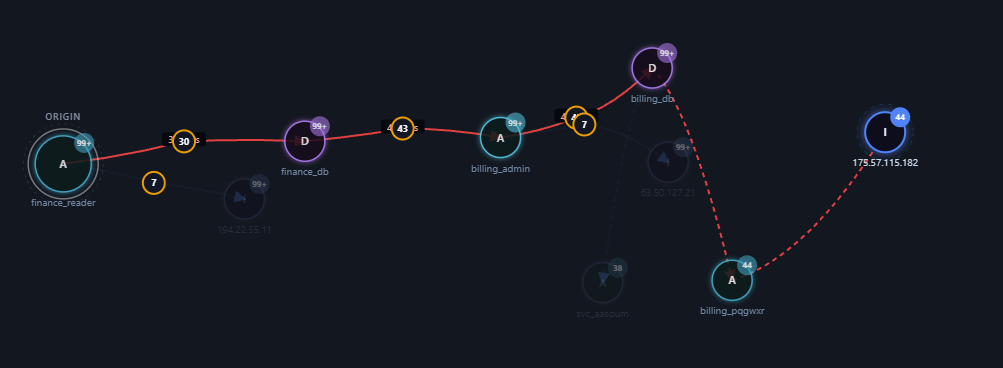
Entity Graph
Accounts, hosts, and databases become persistent objects with behavioural history. Relationships are computed from real activity and scored by evidence weight, so an attack path reads at a glance.
CRUDGuard
CRUDGuard ingests activity from your databases and any other log source, and turns it into threat narratives with entities, timelines, behavioural context, and explicit confidence levels.
Get startedEvery breach that matters ends at the data layer, where customer records, credentials, and financial and health data live. CRUDGuard runs a SIEM-style ingest, detect, and triage workflow scoped to that layer. It reads the query and connection activity your databases already emit and works out who is behind each action, what that account has done before, and whether the behaviour fits a known threat.
Core Workflow
Accounts, hosts, and databases become persistent objects with behavioural history. Relationships are computed from real activity and scored by evidence weight, so an attack path reads at a glance.
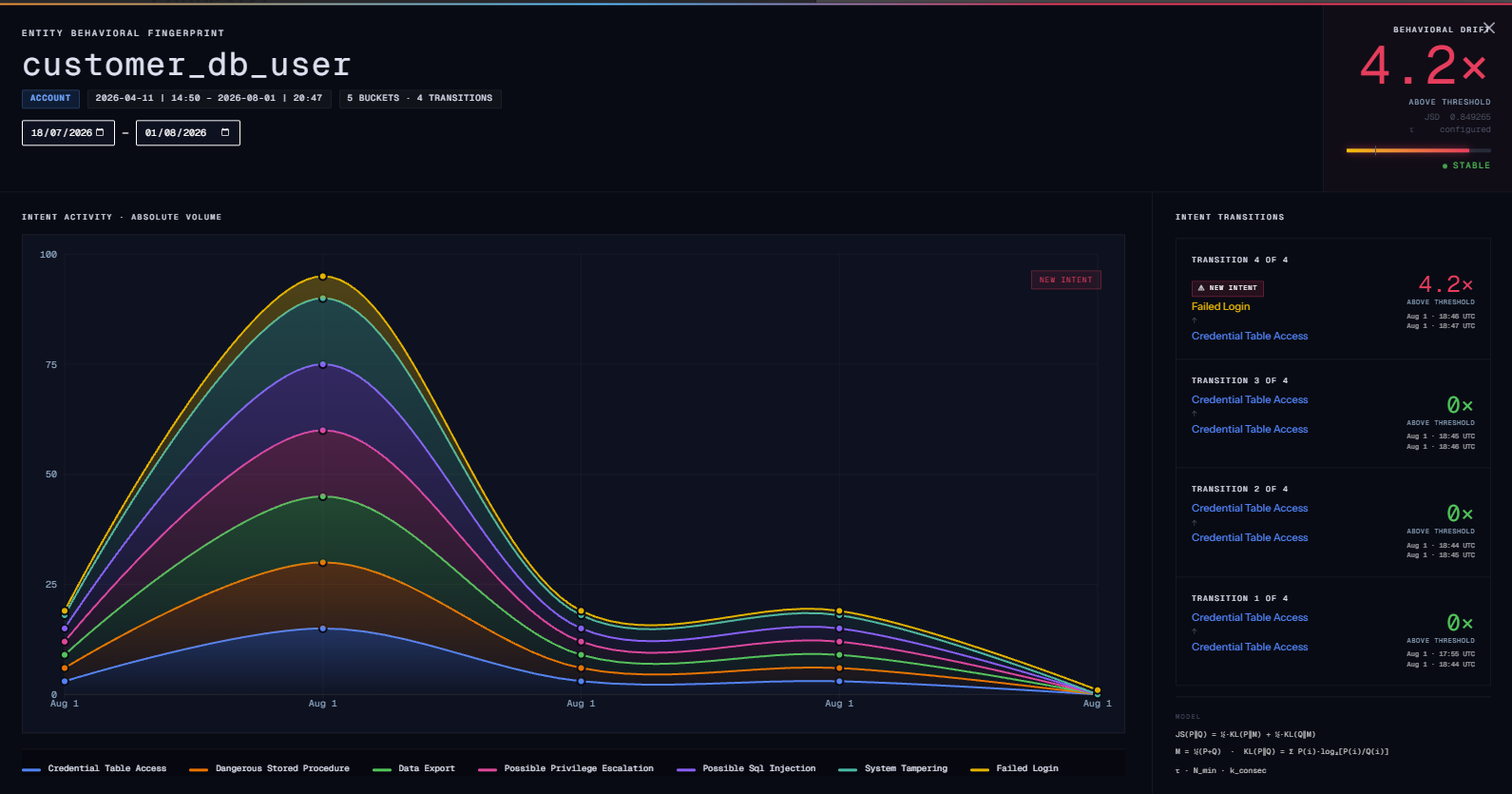
Behavioural sequences become stories, and related stories build into a hypothesis an analyst can follow as a single timeline, with the behavioural drift that triggered it scored against the entity's own baseline.
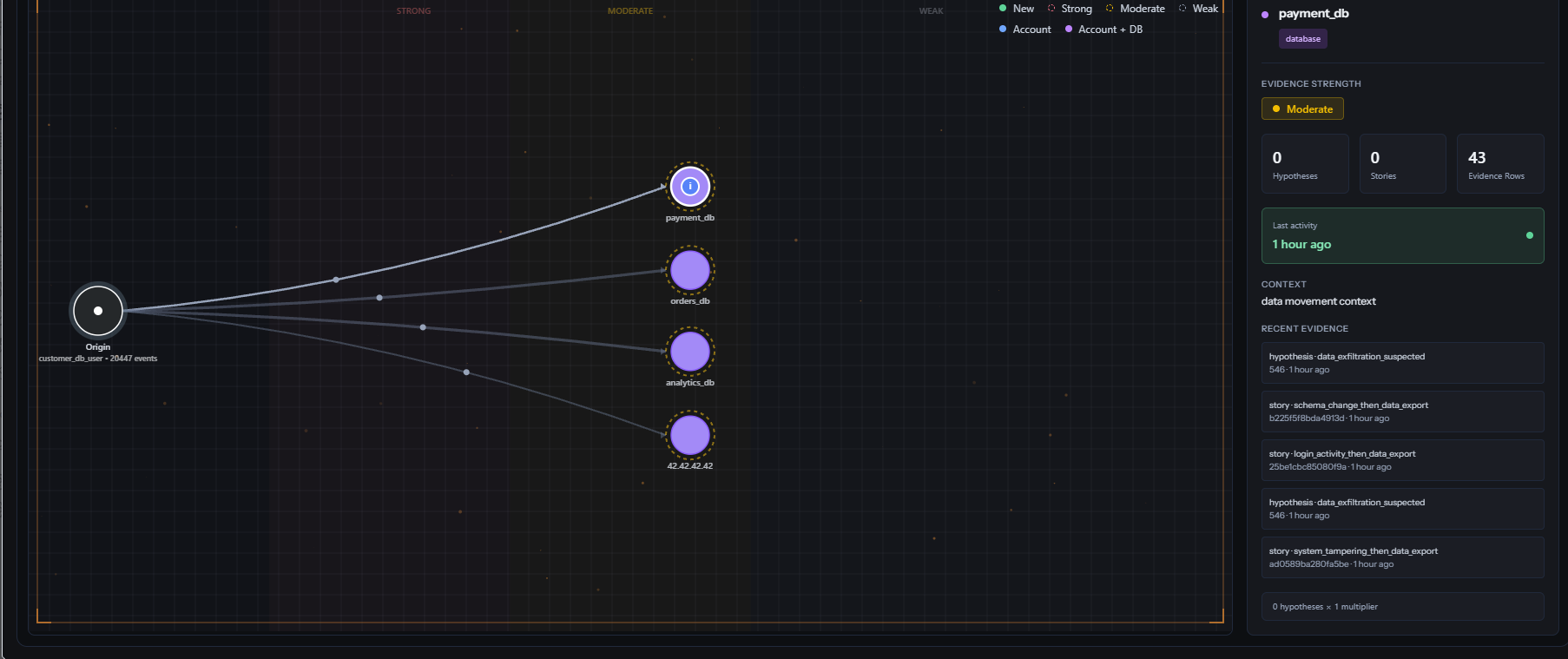
Raw observations never change. Every hypothesis and story keeps the evidence rows behind it, so any finding can be replayed against what it rests on when an auditor or regulator asks.
Connect PostgreSQL, MySQL, MSSQL, IBM Informix, MongoDB, Oracle, cloud-native stores, or any other log source. The adapter-driven architecture brings a new telemetry source online in minutes to hours and normalizes it into one cross-referenced stream.
Temporal patterns are evaluated per entity against the live stream. Threshold violations and slow behavioural drift both register, turning multi-step attack sequences into trackable stories with explicit evidence chains.
Each hypothesis arrives with a confidence score and its MITRE ATT&CK mapping, ranked so analysts work the strongest signals first. Every one opens with its full timeline and the exact evidence chain that produced it.
Each entity is scored against its own baseline with Jensen-Shannon Divergence, catching slow drift that no single rule would trip.
Paths from suspicious entities to crown-jewel data are mapped continuously, so lateral movement shows up before compromise completes.
Threshold violations and behavioural sequences become stories you can track, each with the evidence chain that built it.
High-confidence hypotheses open cases on their own, each carrying the story chain and MITRE technique that triggered it.
First-seen and reactivation events fire with no training period, so a dormant account that resurfaces gets noticed.
Suppression rules are preserved as analytical decisions, each one time-bounded and tracked by how often it fires.
Real-world use case
CRUDGuard answers the questions an alert never asks: what is this entity, what has it done before, does this fit a known threat pattern, and how confident are we?
Ask Turing Tower
A real expert answers your questions
Ask a question and a Turing Tower expert replies, usually within one working day. Members get priority.
Prefer to talk? Book a call
Thanks, we have your question.
We will reply to , usually within one working day.
Answered by real people.